Here We Go Again Cast Fibber Mcgee and Molly Who Played Charlie Mccarthy Dancing
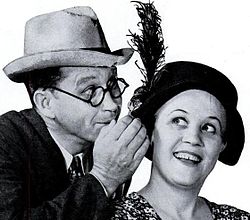 Jim and Marian Jordan as Fibber McGee and Molly in 1937 | |
| Country | United states of america |
|---|---|
| Languages | English |
| Home station | WMAQ AM NBC |
| Starring | Jim Jordan Marian Jordan |
| Announcer | Harlow Wilcox |
| Air dates | April xvi, 1935 to 1959 |
| Sponsor(due south) | Johnson's Wax Pet Milk Reynolds Aluminum |
Fibber McGee and Molly was an American radio comedy series which maintained its popularity over decades. Information technology premiered on NBC in 1935 and continued until its demise in 1959, long afterwards radio had ceased to be the dominant form of entertainment in American popular culture.
Contents
- 1 Married man and wife in real life
- 2 From vaudeville to Smackout
- three From Smackout to Wistful Vista
- iv Recurring characters
- five Running gags
- 5.ane The Closet
- six Sponsors
- vii Spin-offs
- 8 Films
- 9 Other films
- 10 Television set
- 11 Changes
- 12 Pop culture
- 13 References
- xiv Listen to
- fifteen External links
Husband and wife in real life
The stars of the program were real-life husband James "Jim" Jordan (16 Nov 1896–1 April 1988) [one] [2] and his wife Marian Driscoll (15 April 1898–7 April 1961), [1] [3] who were natives of Peoria, Illinois.
Hashemite kingdom of jordan was the seventh of eight children born to James Edward Jordan and Mary (née Tighe) Jordan, while Driscoll was the 7th and last child born to Daniel P. and Anna (née Carroll) Driscoll. The son of a farmer, Jim wanted to be a singer; Marian, the girl of a coal miner, wanted to be a music teacher. Both attended the same Catholic Church, where they met at choir exercise. Marian'south parents had attempted to discourage her professional singing and acting aspirations. When she started seeing immature Jim Jordan, the Driscolls were far from approval of Jim and his ideas. Jim'southward voice teacher gave him a recommendation for work every bit a professional in Chicago, and he followed it. He was able to have steady work but presently tired of the life on the road. In less than a yr, Jim came back to Peoria and went to work for the Post Office. His profession was now adequate to Marian'south parents, and they stopped objecting to the couple'south marriage plans. The pair were married in Peoria, Illinois on August 31, 1918. [4]
5 days after the wedding, Jim received his draft observe. He was sent to France and became office of a military touring group which entertained the armed forces after World War I. [4] When Jim came home from France, he and Marian decided to try their luck with a vaudeville act. [5] [6] They had 2 children, Kathryn Therese Jordan (1920–2007) and James Carroll Hashemite kingdom of jordan (1923–1998), both born in Peoria. Marian returned home for the nascency of Kathryn but went dorsum to performing with Jim, leaving her daughter with Jim's parents. Afterward Jim Jr. was built-in in 1923, Marian stayed with the children for a time, while Jim performed equally a solo act. Marian and the children joined him on the route for a short time, simply the couple had to admit defeat when they plant themselves in Lincoln, Illinois in 1923 with two modest children and no funds. The couple's parents had to wire them money for their return to Peoria. Jim went to piece of work at a local section store but still felt the attraction of existence in testify business. He and Marian went back into vaudeville. [4]
While staying with Jim's brother in Chicago in 1924, the family was listening to the radio; Jim said that he and Marian could practice better than the musical act currently on the air. Jim's blood brother bet him $10 that they could non. To win the bet, Jim and Marian went to WIBO, [7] where they were immediately put on the air. At the stop of the performance, the station offered the couple a contract for a weekly show which paid $x per calendar week. The sponsor of the prove was Oh Henry! candy, and they appeared for six months on The Oh Henry! Twins plan, switching to radio station WENR by 1927. [iv] [6] [eight]
When it appeared to the couple that they were financially successful, they built a home in Chicago which was a replica of their rented home, complete to building it on the lot next door. For their 1939 movement to the West Coast, the Jordans selected a inconspicuous abode in Encino. Some of Jim Jordan's investments included the bottling company for Hires Root Beer in Kansas City. [9]
From vaudeville to Smackout
Fibber McGee and Molly originated when the minor-time married man-and-wife vaudevillians began their third year as Chicago-expanse radio performers. Two of the shows they did for station WENR start in 1927, both written past Harry Lawrence, bore traces of what was to come and rank equally one of the primeval forms of situation comedy. In their Luke and Mirandy subcontract-written report programme, Jim played a farmer who was given to tall tales and confront-saving lies for comic effect. [4] In a weekly one-act, The Smith Family, Marian'southward graphic symbol was an Irish married woman of an American police officer. These characterizations, plus the Jordans' change from being singers/musicians to comic actors, pointed toward their hereafter; information technology was here where Marian developed and perfected the radio graphic symbol "Teeny". [half-dozen] [ten] Information technology was also at WENR where the Jordans met Donald Quinn, a cartoonist who was so working in radio, and the couple hired him as their writer in 1931. They regarded Quinn's contribution as important and included him as a full partner; the salary for Smackout and Fibber McGee and Molly was split between the Jordans and Quinn. [4] [9]
While working on the WENR subcontract report, Jim Hashemite kingdom of jordan heard a true story most a shopkeeper from Missouri whose shop was brimming with stock, yet he claimed to be "smack out" of any a customer would ask him for. The story reached the halls of nearby Columbia College, and the students began visiting the store, which they chosen "Smackout", to hear the owner's incredible stories. [iv]
For station WMAQ in Chicago, beginning in April 1931, the trio created Smackout, a 15-infinitesimal daily programme which centered on a general store and its proprietor, Luke Gray (Jim Hashemite kingdom of jordan), a storekeeper with a penchant for tall tales and a perpetual famine of whatever his customers wanted: He always seemed "smack out of it." [9] Marian Jordan portrayed both a lady named Marian and a little girl named Teeny, likewise as playing musical accessory on piano. During the testify'due south run, Marian Jordan voiced a full of 69 unlike characters in it. [four] Smackout was picked up by NBC in April 1933 and circulate nationally until August 1935. [11]
A member of the S.C. Johnson visitor's owners, Henrietta Johnson Lewis, married to the advertizement executive who handled the Johnson's Wax account, recommended that her husband, John, requite the show a risk as a national programme for the company. Part of the terms of the arrangement between the Jordans and Johnson's Wax gave the company ownership to the names of Fibber McGee and Molly. [9]
From Smackout to Wistful Vista
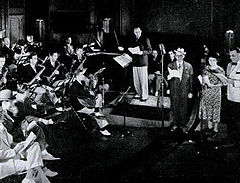

Fibber McGee and Molly from Chicago, 1937.
If Smackout proved the Jordan-Quinn spousal relationship's viability, their adjacent creation proved their virtually enduring. Amplifying Luke Grey's tall talesmanship to Midwestern braggadocio, Quinn developed Fibber McGee and Molly with Jim as the foible-prone Fibber and Marian playing his patient, mutual sense, honey-natured wife. The show premiered on NBC April 16, 1935, and though it took three seasons to become an irrevocable hit, it became the country's top-rated radio series. [6] In 1935, Jim Jordan won the Burlington Liars' Club title with a story about catching an elusive rat. [12]
Existing in a kind of Neverland where money never came in, schemes never stayed out for very long, all the same no one living or visiting went wanting, 79 Contemplative Vista (the McGees' address from evidence #20, Baronial 1935 onward) became the home Depression-exhausted Americans visited to remind themselves that they were not the but ones finding cheer in the middle of struggle and doing their best not to make information technology overt. The McGees won their business firm in a raffle from Mr. Hagglemeyer's Wistful Vista Development Company, with lottery ticket #131,313, happened upon by chance while on a pleasure drive in their car. With blowhard McGee wavering between mundane tasks and hare-brained schemes (like excavation an oil well in the dorsum yard), antagonizing as many people as possible, and patient Molly indulging his foibles and providing loving support, not to mention a tireless parade of neighbors and friends in and out of the quiet home, Fibber McGee and Molly built its audience steadily, but in one case it found the full book of that audience in 1940, they rarely allow become of it. [4]
Marian Jordan took a protracted absence from the show in November 1937 to Apr 1939 to deal with a lifelong battle with alcoholism, although this was attributed to "fatigue" in public statements at the time. [9] The show was retitled Fibber McGee and Company during this interregnum, with scripts cleverly working effectually Molly'south absenteeism (Fibber making a speech at a convention, etc.). Comedienne ZaSu Pitts appeared on the Fibber McGee and Visitor show, every bit did vocaliser Donald Novis. In January 1939, the prove moved from NBC Chicago to the new NBC West Coast Radio Urban center in Hollywood. [13]
Recurring characters
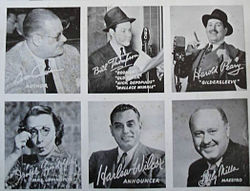
The other cast members circa 1939.
Fibber McGee and Molly was 1 of the earliest radio comedies to use regular characters, nearly all of whom had recurring phrases and running gags. These included:
- Throckmorton P. Gildersleeve (Harold Peary) - the pompous next-door neighbor with whom Fibber enjoyed twitting and arguing. Introduced in 1939.
- The Old-Timer (Nib Thompson) - a difficult-of-hearing senior denizen with a penchant for distorting jokes, prefacing each one past saying, "That ain't the way I heared information technology!" For no apparent reason, he refers to Fibber equally "Johnny" and Molly as "Girl". A recurring joke is that he refuses to tell his existent name. In the 1940 episode "Mailing Christmas Packages", he is referred to by another character equally "Roy", while in one episode (01/29/1946 and reiterated in the episode a week afterward) he claims his proper noun is "Rupert Blasingame." As well, three/fourteen/39 episode, Fibber calls him Mr. Sims, merely he's having trouble with his memory in this episode, and so this may be just an error in remembering, as he too calls Mr. Wilcox "Harpo" for peradventure the commencement time instead of Harlow, due to poor memory tricks.
- Teeny, also known every bit "Little Girl" and "Sis" (Marian Hashemite kingdom of jordan) - a precocious youngster who usually tried to cadge loose change from Fibber. Ending one-half her sentences with "I'thou hungry!" and "I betcha!", Teeny was also known to lose track of her own conversations. When Fibber showed involvement in what she was saying, she would forget all about information technology. Her conversation would switch from telling to request. When Fibber would repeat all she had been telling him, Teeny would respond "I know it!" in a condescending fashion. Her appearances were usually foreshadowed by Molly excusing herself to the kitchen and Fibber wistfully delivering a compliment to her starting, "Ah, there goes a skilful kid", upon which the doorbell would ring and Teeny would appear. On rare occasions Molly and Teeny would collaborate. [9]
- Mayor LaTrivia (Gale Gordon), whose name was inspired by New York's famous mayor Fiorello La Guardia. In later episodes, Fibber occasionally addresses the mayor as "Homer", although it is unclear whether this is his actual first proper name, or just another of the show's random unexplained naming gags, as The Former Timer's calling Fibber "Johnny", supra. The McGees' regular routine with LaTrivia entailed Fibber and Molly misunderstanding a figure of speech, in much the same vein as Abbott & Costello's Who'south On Showtime? routine. LaTrivia would slowly progress from attempting patient caption to tongue-tied rage, in Gale Gordon'southward classic tedious-burn.
- Foggy Williams (Gordon) - local weatherman and next-door neighbor who tells fanciful stories, lets Fibber borrow his tools, takes credit or blame for the present atmospheric condition conditions exits with the line "Adept solar day... probably."
- Billy Mills - wisecracking leader of Billy Mills and the Orchestra, who played brusk instrumentals in the first one-half of each episode.
- Dr. Chance (Arthur Q. Bryan) - a local physician and surgeon with whom Fibber had a long-standing rivalry and friendship.
- Ole Swenson (Richard LeGrand, who also played Mr. Peavey on The Swell Gildersleeve) - a Swedish-built-in janitor at the Elks Club, always complaining that he was "joost donatin' my fourth dimension!".
- Mrs. Abigail Uppington (Isabel Randolph) - a snooty society matron whose pretensions Fibber delighted in deflating. Fibber ofttimes addressed her as "Uppy".
- Mrs. Millicent Carstairs (Bea Benaderet) - some other of Wistful Vista'due south loftier guild matrons, known to Fibber equally "Carsty".
- Wallace Wimple (Thompson) - a hen-pecked husband constantly dominated and physically dilapidated past "Sweetieface," his "big ol' married woman", Cornelia, who never appeared on the bear witness. Surprisingly, this key character was not introduced until the first show of their 7th year on the air, 4/fifteen/41. This character may have contributed to the employ of the give-and-take "wimp" to describe a weak-willed person.
- Alice Darling (Shirley Mitchell) - a ditzy aircraft-establish worker who boarded with the McGees during the state of war.
- Horatio G. Boomer (Thompson) - a con artist with a W. C. Fields-like voice and commitment. [9]
- Nick Depopoulous (Thompson) - a Greek-born restauranteur with a tendency toward verbal malapropisms. [9]
- Myrtle, also known as "Myrt" - a never-heard telephone operator that Fibber is friends with. A typical Myrt sketch started with Fibber picking up the phone and enervating, "Operator, give me number 32Oooh, is that you, Myrt? How's every little matter, Myrt?" Commonly, this was followed with Fibber relaying what Myrt was telling him to Molly, unremarkably news about Myrt's family, and ever ending with a bad pun. Myrtle made one brief on-air appearance on June 22, 1943 when she visited the McGees to wish them a good summertime—the McGees did non recognize her in person.
- Fred Nitney - Some other never-heard grapheme, Fibber's sometime vaudeville partner from Starved Stone, Illinois.
The near unusual character might have been the McGees' blackness maid, Beulah. Unlike the situation on The Jack Benny Plan, where blackness actor Eddie Anderson played "Rochester", Beulah was voiced past a Caucasian male, Marlin Hurt. The character'due south usual opening line, "Somebody bark fo' Beulah??", often provoked a stunned, screeching sort of laughter among the live studio audience; many of them, seeing the show performed for the outset fourth dimension in person, did not know that the actor voicing Beulah was neither black nor female, and expressed their surprise when Hurt delivered his line. Her other catchphrase was "Dearest that man!" subsequently a fit of laughter over a Fibber gag. Injure had created the Beulah character independently and had portrayed her occasionally on other shows prior to his joining the Fibber McGee and Molly bandage. [6]
The character of Uncle Dennis (Ransom Sherman), who was the bailiwick of a running gag (run into below) and was by and large never heard, did announced in a few episodes in 1943, including "Renting Spare Room" (October 5, 1943) and "Fibber Makes His Ain Chili Sauce" (November 9, 1943).
Running gags
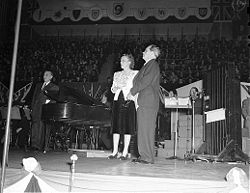
Jim and Marian Jordan, equally Fibber McGee and Molly, at a Victory Bond rally at Maple Foliage Gardens in Toronto in 1945. Notation sound effects men and equipment at right.
Much of the testify'southward humor relied on recurring gags, unseen regulars and punchlines that sometimes popped up hither and there for years. The show would unremarkably open the 29-and-a-half minute broadcast with the audience in full laughter with Harlow Wilcox announcing, "The Johnson Wax Program with Fibber McGee and Molly!" The episode of December 19, 1944, "Fibber Snoops For Presents In Closet" (at three:59 is a perfect example of the "Hall Closet," a running gag described in detail afterward in this entry), Jim Jordan tin be caught at the finish of his audience warm-up evoking the opening laughter by quipping, "x seconds? Oh, we got a lot of.... Ooooo!"
For virtually of the show's history, the usual order of the show is the introduction followed by a Johnson Wax plug by Harlow and then his introduction to Department 1 of the script (usually 11 minutes). Billy Mills normally follows with an instrumental (or accompanied by Martha Tilton in 1941). That musical interlude then segues to Section 2 of the script, followed by a performance by the vocal group, The Kings Men (occasionally featuring a solo by leader Ken Darby). The final human action then ensues, with the last line usually showing the lesson learned that day, a last commercial, and then Baton Mills' theme vocal to fade. Subsequently, Harlow would meet up and visit with the McGees and piece of work in a Johnson Wax commercial, sometimes assisted by Fibber and Molly.
When McGee tells a bad joke, Molly normally answered with the line "T'aint funny, McGee!" which became a familiar catch phrase during the 1940s. [14] Molly's Uncle Dennis is ane of the more common unseen regulars (though he has gotten in a rare line here and there); often referred to, and sometimes heard making noise. He lives with the McGees, and is plain an enormous alcoholic, becoming a punch line for many Fibber jokes and even the chief bailiwick of some shows in which he "disappeared."
McGee is never mentioned every bit having a task. However, Mayor LaTrivia oftentimes offers McGee jobs at City Hall, the jobs usually sounding exciting when the duties are vaguely described, but always ending up being very mundane when the actual job is named. For instance, a chore "looking in on the higher-ups at Metropolis Hall" turns out to be a window-cleaning job. Another interesting assignment was to exist where McGee would demand to maintain a disguise to remain deep undercover for days at a time, just equally the Contemplative Vista Santa Claus.
McGee, apparently, is very proud of by deeds, sometimes recalling an interesting nickname he picked upwardly over the years. Each one of these nicknames is, every bit usual with Fibber, a bad pun. When someone told a human being named Addison that McGee was a glib talker, McGee became known equally "Advertizing Glib McGee." Or, when Fibber made expressions with his eyes, he was nicknamed "Optics-a-muggin' McGee" (a play on the pop Andy Kirk swing tune "I'se A-muggin'"). From there Fibber jumps headfirst into a long, breathless and boastful description of his nickname, using an impressive corporeality of alliteration.
Mentioned for a time on the program was Otis Cadwallader, a schoolmate of Fibber and Molly in Peoria, and Molly's boyfriend before McGee entered the picture. Fibber has a long-standing grudge against Otis, making him out to seem like a self-centered, overblown hack, despite seemingly everyone else seeing Cadwallader every bit a lovely, dashing man. Never mentioned are Otis'southward feelings toward Fibber, giving the impression that Fibber'south grudge is 1-sided. As revealed tardily in 1942, Fibber'southward anger is actually a front to keep Cadwallader away, as Fibber once borrowed money from Otis and never paid it dorsum.
The "corner of 14th and Oak" in downtown Contemplative Vista was routinely given equally a location for various homes, places of business and government buildings throughout the show'southward run.
The Cupboard
None of the show'due south running gags were as memorable or enduring as The Closet—McGee's oftentimes opening and cacophonous closet, bric-a-brac clattering down and out and, often enough, over McGee's or Molly'southward heads. "I gotta become that closet cleaned out one of these days" was the usual McGee observation once the dissonance subsided. Naturally, "one of these days" near never arrived. A good matter, likewise: in ane famous instance, when a burglar (played by Bob Bruce) tied up McGee, McGee informed him cannily that the family'southward silvery was "right through that door, bud... just yank it open, bud!" Naturally, the burglar took the bait and naturally, he was cached in the inevitable avalanche, long enough for the police to auscultate him.
This gag appears to have begun with the March 5, 1940 show, "Cleaning the Closet." Molly opens the closet looking for the dictionary and is promptly cached in Fibber'south "stuff" ("bundled in at that place only the way I want it.") Cleaning out the closet becomes the evidence's plot, inventorying much of the contents along the fashion: a photo album, a rusty horseshoe, a x-foot pole. After repacking the closet, Fibber realizes the dictionary has been put away besides—and he opens the cupboard again. This episode also features a cameo by Gracie Allen, running for president on the Surprise Political party ticket. Toward the end the September 30, 1940 show, "Back from Vacation; Gildy Says Goodbye," next-door nemesis Gildersleeve---who has moved to Summerfield to finish raising his orphaned niece and nephew (and already begun his successful spin-off show The Dandy Gildersleeve), just has come up back to Wistful Vista to wind upwardly his affairs there, in a farewell to the testify that made him famous---opens the closet to be cached in the usual avalanche.
On at to the lowest degree one occasion, the gag is flipped, and the closet is silent: in "Too Much Free energy" (circulate January 23, 1945), visiting Dr. Hazard makes to go out. Molly warns, "No, Medico, non through that door, that's the hall closet!" Equally the audience chuckles slightly in anticipation, Fibber explains: "Oh I forgot to tell you, Molly, I straightened out the hall closet this morning!" This was certainly not the terminate of the gag, though, every bit the closet soon became chaotic one time again, leading to many more than disasters.
Like many such trademarks, the clattering closet began as a one-fourth dimension stunt, but "the closet" was developed carefully, not being overused (it rarely appeared in more than than two sequent installments, though it never disappeared for the same length, either, at the height of its identification, and it rarely collapsed at exactly the same time from bear witness to bear witness), and information technology became the all-time-known running audio gag in American radio's classic period. Jack Benny'south basement vault alarm ran a afar 2d. Both of these archetype audio furnishings were performed by Ed Ludes and Virgil Rhymer, Hollywood-based NBC staff sound effects creators. Exactly what tumbled out of McGee's closet each time was never articulate (except to these sound-effects men), but what signaled the end of the avalanche was always the aforementioned audio: a clear, tiny, household mitt bell and McGee's inevitable postmortem. [6] "Fibber McGee'southward closet" entered the American colloquial as a catch phrase synonymous with household ataxia.
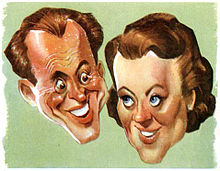
Jim and Marian Jordan as caricatured by Sam Berman for 1947 NBC promotional volume.
Each episode also featured an appearance by announcer Harlow Wilcox, whose job it was to weave the second advertising for the sponsor into the plot without having to break the show for a real commercial. Wilcox's introductory pitch lines were usually met with groans or humorously sarcastic lines by Fibber. During the many years that the bear witness was sponsored by Johnson Wax, Fibber nicknamed Wilcox "Waxy", due to Wilcox's constant praises of their various products. In a style not unusual for the classic radio years, the show was typically introduced equally, "The Johnson Wax Program, with Fibber McGee and Molly." Johnson Wax sponsored the show through 1950; Pet Milk through 1952; and, until the testify'southward final half-hr episode in mid-1953, Reynolds Aluminum. Wilcox was sometimes chosen Harpo by Fibber.
The show too used 2 musical numbers per episode to break the comedy routines into sections. For most of the show'south run, there would exist ane vocal number past The Male monarch'southward Men (a vocal quartet: Ken Darby, Rad Robinson, Jon Dodson, and Bud Linn), and an instrumental by The Baton Mills Orchestra. For a curt time in the early 1940s, Martha Tilton would sing what was formerly the instrumental.
Earlier and during America's involvement in Earth War II, references to or about the state of war and the members of the Axis Powers were commonplace on the bear witness. Merely after the Japanese attacked Pearl Harbor in Dec 1941, Jim Hashemite kingdom of jordan, out of character, soberly concluded the Fibber McGee bear witness past inviting the studio audition to sing "America". Too commonplace were calls to activity to buy defence bonds (both through announcements and subtle references written into the script), and condemnation of food and supply hoarding. Though understandably office of the backlash reaction toward the Pearl Harbor attack, some jokes nearly the Empire of Japan certainly would be considered politically incorrect on today'due south airwaves. For instance, in the episode "Fix-It McGee", aired three weeks after Pearl Harbor, Fibber tells Mayor LaTrivia his "great slogan" for the war bond entrada: "Every time yous buy a bond, you slap a Jap across the pond." The term "Jap" was in common usage in nigh all American media during this menstruation.
On the other paw, the Jordans gladly cooperated in turning the show over to a half-hour devoted entirely to patriotic music on the day of the D-Day invasion in 1944, with the couple speaking but at the opening and the endmost of the broadcast. This testify remains bachelor to collectors amongst many a Fibber McGee and Molly packaging.
When the shows were broadcast overseas by the Armed Forces Radio Service (AFRS), all 3 commercials were eliminated from the program. Harlow Wilcox'south heart ad was edited out, and the 2 advertisements at the get-go and end of the show were replaced past musical numbers, and then that the prove on AFRS would have two numbers past Billy Mills and the Orchestra, and ii past The King'south Men.
The Jordans were experts at transforming the ethnic humor of vaudeville into more rounded comic characters, no dubiousness due in part to the affection felt for the famous supporting bandage members who voiced these roles, including Bill Thompson (equally the Old Timer and Wimple), Harold Peary (as Gildersleeve), Gale Gordon (every bit LaTrivia), Arthur Q. Bryan (as Dr. Gamble; Bryan also voiced Elmer Fudd for the Warner Brothers Looney Tunes cartoons, which as well borrowed lines from Fibber McGee and Molly from time to time), Isabel Randolph (equally Mrs. Uppington), Marlin Hurt (a white male who played in dialect the McGee'south maid, Beulah), and others. They were likewise expert at their own running gags and catch phrases, many of which entered the American vernacular: "That own't the style I heeard it!"; "'T ain't funny, McGee!" and "Heavenly days!" were the three all-time known.
Spin-offs
Fibber McGee and Molly spun ii supporting characters off into their own shows. By far the nearly successful and popular was Harold Peary's Gildersleeve, spun into The Great Gildersleeve in 1941. This show introduced single parenthood of a sort to artistic broadcasting: the pompous, previously married Gildersleeve now moved to Summerfield, became unmarried (although the missing wife was never explained), and raised his orphaned, spirited niece and nephew, while dividing his time between running his manufacturing business organisation and (eventually) becoming the town water commissioner. [4] In 1 episode, the McGees arrived in Summerfield for a visit with their old neighbor with hilarious results: McGee inadvertently learns Gildersleeve is engaged, and he practically needs to exist chloroformed to perpetuate the secret a little longer.
Peary returned the favor in a memorable 1944 Fibber McGee & Molly episode in which neither of the title characters appeared: Jim Jordan was recovering from a tour of pneumonia (this would be written into the bear witness the following calendar week, when the Jordans returned), and the story line involved Gildersleeve and nephew Leroy hoping to visit the McGees at home during a train layover in Wistful Vista, but finding Fibber and Molly not at home. At the terminate of the episode, Gildersleeve discovers the couple had left in a hurry that morning when they received Gildy's letter saying he would be stopping over in Wistful Vista.
Marlin Hurt's Beulah was too spun off, leading to both a radio and television show that would eventually star Hattie McDaniel and Ethel Waters.
Jim and Marian Jordan themselves occasionally appeared on other programs, abroad from their Fibber and Molly characters. [9] One memorable episode of Suspense ("Backseat Driver," 02-03-1949) bandage the Jordans equally victims of a auto-jacking; Jim Hashemite kingdom of jordan's tense, interior monologues were especially dramatic.
Films
The Jordans portrayed their characters in four movies. In the early years of the radio show, they were supporting characters in the 1937 Paramount motion-picture show This Way, Delight, starring Charles "Buddy" Rogers and Betty Grable. In one case the show hit its pace, they had leading roles in the RKO Radio Pictures films Expect Who's Laughing (1941), Here We Go Once again (1942) and Heavenly Days (1944).
The first two RKO films are generally considered the best, every bit they co-star boyfriend radio stars Edgar Bergen and Charlie McCarthy. Harold Peary besides appears in both every bit Gildersleeve, with Arthur Q. Bryan, Nib Thompson, Harlow Wilcox, Gale Gordon, and Isabel Randolph appearing in both their prove roles and every bit other characters. Beak Thompson in Look Who's Laughing played ii parts: The pushy sales-man, and the human who shouted "It's Hillary Horton". Gale Gordon played Otis Cadwalader, Molly's ex-boyfriend in Hither Nosotros Go Again. Arthur Q. Bryan played the Mayor's aide in Wait Who's Laughing.
Look Who'southward Laughing has been released on VHS equally part of the Lucille Brawl Collection, and Hither We Go Once more has been released on VHS in rental format only. Look Who'south Laughing, Here We Become Again and Heavenly Days have been shown on Turner Classic Movies.
Other films
Other films featured the McGees' neighbors. The commencement film was called Comin' Round the Mount (1940) and featured the McGees' neighbors The Old-Timer (played past Nib Thompson) and Gildersleeve, as the mayor of the town. Gildersleeve's character was in many other films before The Bully Gildersleeve show and movies. Abigale Uppington is in the film County Fair along with Harold Peary, and his hereafter radio bear witness co-star Shirley Mitchell (who also played Leila Ransom in The Great Gildersleeve).
Television
An attempt at getting the McGees onto television set came in September 1959, produced past William Asher for NBC (and co-sponsored by Vocalizer Corporation and Standard Brands), with younger actors Bob Sweeney and Cathy Lewis in the roles. The evidence likewise featured Harold Peary as Mayor LaTrivia, rather than as Gildersleeve. The evidence was unable to recreate the flavor and humor of the original and did not survive its first season; in fact, information technology did not even last through January 1960. Merely the Jordans themselves had resisted television set far earlier. "They were trying to push us into Boob tube, and nosotros were reluctant," Jim Jordan told an interviewer many years later. "Our friends advised us, 'Don't do it until you need to. You have this value in radio—milk it dry out.'"
Changes
Due in large part to Marian Jordan's periodic wellness bug, Fibber McGee and Molly became a nightly xv-minute evidence in 1953, recorded without a studio audience in single sessions, the better to enable Marian Jordan to remainder. The timing was sadly appropriate, as archetype radio had entered its dying days. Still, the McGees remained a favorite presence on radio, even after the quarter-hr edition ended in 1956, appearing in short segments on the NBC radio prove Monitor—under the rubric Just Molly and Me—from 1957 to 1959.
Radio historian Gerald Due south. Nachman has noted the Jordans were gear up to renew with NBC for at to the lowest degree three more years when Marian's battle confronting cancer concluded in her death in 1961. In the 1970s, Jim Jordan briefly returned to acting. An episode of NBC's Chico and the Human featured a surprise appearance by Jordan as a friendly neighborhood mechanic. Hashemite kingdom of jordan also lent his voice to Disney'southward animated flick The Rescuers (1977). He died in 1988—a year before Fibber McGee and Molly was inducted into the Radio Hall of Fame.
Jim Jordan married Gretchen Stewart after Marian's death. Gretchen and the Hashemite kingdom of jordan children donated the manuscripts of Smackout and Fibber McGee and Molly to Chicago's Museum of Broadcast Communications after his death in 1988. [4] [15]
The show likewise has a star on the Hollywood Walk of Fame—right adjacent to the building that once housed the NBC radio studios where the Jordans performed the testify for and then long. [6] The Due south.C. Johnson Company preserved more than than 700 recordings of the show it sponsored for 15 years.[ commendation needed ]
Popular culture
- In The Homecoming: A Christmas Story, a 1971 TV movie that served as a airplane pilot for the serial The Waltons, Grandpa (played by Edgar Bergen) is seen listening to a 1947 Christmas episode of Fibber McGee and Molly, in which Teeny explains that she and her friends take been practicing their Christmas carol. (The scene is an anachronism, as the movie is gear up in 1933 - before Fibber McGee and Molly had even premiered.)
- On the NBC situation comedy NewsRadio, in the episode entitled Xmas Story, Jimmy James (played by Stephen Root) is said to ain the rights to Fibber McGee and Molly, which he gives to Matthew Brock (played by Andy Dick) every bit a Christmas nowadays.
- Given the popularity of the radio testify at the time many take hold of phrases appear oft in Warner Bros. drawing shorts from the 1930s and 1940s, such as Molly's "T'ain't funny, McGee!" (Daffy Duck and Egghead, 1938 and Holiday Highlights, 1940), Picayune Daughter'due south "I betcha." (The Sneezing Weasel, 1938), Mr. Old Timer's "That own't the mode I heared information technology, Johnny!" (Tortoise Wins by a Hare, 1943), and "Is that you lot, Myrt?" (Daffy the Commando, 1943 and The Wabbit Who Came to Supper, 1942). The Gildersleeve grapheme was parodied in the 1945 Bugs Bunny cartoon Hare Conditioned, in which the rabbit distracts a menacing taxidermist by telling him that he sounds "only like that guy on the radio, the Great Gildersneeze!" The taxidermist responds with "I exercise?!" followed past Gildy's famous chuckle. The Gildersleeve voice in this drawing was washed by radio role player and vocalisation artist Dick Nelson.
- Tex Avery's 1945 cartoon The Shooting of Dan McGoo has a scene where the villain tells the championship character, "T'own't funny, McGoo!" - then turns to the camera and says in disgust, "What corny dialogue!"
- In a scene from the 1973 motion-picture show Paper Moon, set in the 1930s, the graphic symbol of Addie is shown listening to Fibber McGee and Molly on the radio and urging Fibber not to open the closet door. (This is an anachronism, as the closet gag wasn't used on the show prior to 1940.)
- The bear witness was frequently referenced during the "riffing" on Mystery Scientific discipline Theater 3000.
- On an episode of NCIS, Abby Sciutto reprimands Timothy McGee with the line "T'own't funny, McGee" equally a nod to the show.
- On The Owl Box, a live web show of barn owls in San Marcos, California, which gained popularity in 2010, the two developed owls are named "Molly" and "McGee" afterward the show.
- In a hospital scene in the 1991 film The Rocketeer, a nurse and security guard are shown listening to the evidence on a radio.
- In Dublin Metropolis Centre In Republic of ireland, there is a Bar named "Fibber McGees" located on Parnell Street which is known for its Heavy Metal and Rock music.
References
- ^ a b Ancestry.com. California Death Index, 1940-1997 [database on-line]. Provo, UT, USA: The Generations Network, Inc., 2000.
- ^ "Jim Hashemite kingdom of jordan, Radio's Fibber McGee, Is Dead at 91", The New York Times, April 2, 1988, p. 10.
- ^ "Marion Jordan, Radio Star, Dies", The New York Times, April 8, 1961, p. 19.
- ^ a b c d e f grand h i j chiliad Dunning, John, ed (1998). On the air: the encyclopedia of old fourth dimension radio. Oxford University Press U.s.a.. pp. 840. ISBN 0195076788. http://books.google.com/books?id=EwtRbXNca0oC&pg=PA246&lpg=PA246&dq=ted+weems+fibber+mcgee#5=onepage&q=ted%20weems%20fibber%20mcgee&f=simulated . Retrieved 28 June 2010.
- ^ Oakland Tribune, November 10, 1935.
- ^ a b c d due east f g "Hollywood Star Walk: Fibber McGee and Molly". LA Times. http://projects.latimes.com/hollywood/star-walk/fibber-molly-mc-gee/ . Retrieved 5 March 2011.
- ^ "WIBO Station History". Zecom Communications. http://67.162.73.47/public/zecom/museum/Chiradhist/560.htm#WIBO . Retrieved 6 March 2011.
- ^ "WENR Station History". Zecom Communications. http://67.162.73.47/public/zecom/museum/Chiradhist/wenr.htm#WENR . Retrieved vi March 2011.
- ^ a b c d e f 1000 h i "Radio: Fibber & co.". Time. 22 April 1940. http://www.time.com/time/magazine/article/0,9171,763865,00.html . Retrieved 5 March 2011.
- ^ Childers, Scott. "WLS History-National Befouled Dance-the Jordans". Childers, Scott. http://www.wlshistory.com/NBD/ . Retrieved 26 Apr 2010.
- ^ Samuels, Rich. "Description of "Smackout" and downloadable audio files". Samuels, Rich. http://world wide web.richsamuels.com/nbcmm/jordans/smackout.html . Retrieved 25 April 2010.
- ^ Burlington Historical Society
- ^ Samuels, Rich. "Fibber McGee & Molly with downloadable sound files". Samuels, Rich. http://www.richsamuels.com/nbcmm/jordans/fmmchicago.html . Retrieved 25 Apr 2010.
- ^ Gary Poole, Radio one-act diary, p. 202, http://books.google.co.great britain/books?id=e_mIk6UtWJMC&pg=PA202
- ^ Anderson, Jon (13 Feb 2004). "TV, Radio Treasures Seek Dwelling house". Chicago Tribune. http://articles.chicagotribune.com/2004-02-13/news/0402130310_1_broadcast-communications-radio-hall-garage-sale . Retrieved 7 March 2011.
Heed to
- Radio Journeys: Smackout (1931)
- McGee and Molly at Free-OTR.com
- Botar: Fibber McGee and Molly (66 episodes)
- Free OTR Fibber McGee and Molly (117 episodes)
- OTR Network Library: Fibber McGee and Molly (442 episodes)
- Internet Annal: Fibber McGee and Molly (hundreds of episodes)
- OTR Fans: Fibber McGee and Molly (seven episodes)
- Fibber McGee & Molly
- Outlaws One-time Time Radio Corner
External links
- Fibber McGee and Molly
- Gale Gordon Archive
- "Kremer's Drugstore" by Steve Kremer
Source: https://en-academic.com/dic.nsf/enwiki/50275
0 Response to "Here We Go Again Cast Fibber Mcgee and Molly Who Played Charlie Mccarthy Dancing"
Post a Comment